
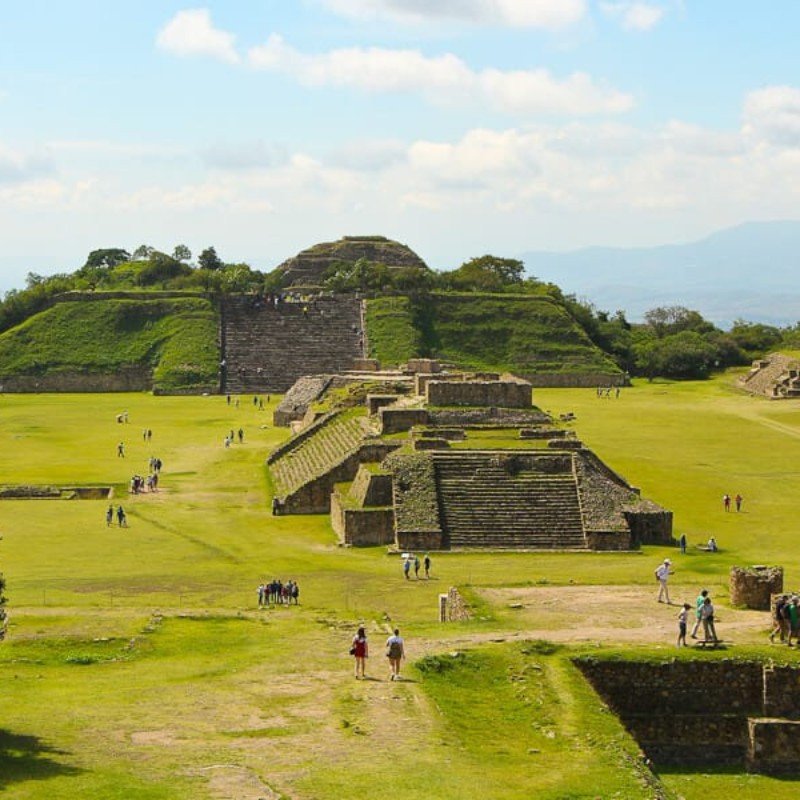
Monte Albán overlooks Oaxaca’s Central Valleys from a mountain reshaped by generations of Zapotec inhabitants. The Great Plaza, platforms, tombs, stelae and buildings are not isolated ruins. Together they form part of an urban and ceremonial project that influenced the region for centuries.
Its proximity to Oaxaca City makes a half-day visit possible, but walking through the site without context can leave many questions unanswered. This guide summarizes its importance, highlights details worth observing and suggests how to combine the archaeological zone with artisan communities for a fuller day.
Why was Monte Albán built on a mountain?
The location is not simply a naturally flat summit. Its inhabitants reshaped the terrain, built terraces and organized ceremonial spaces visible from different parts of the valley. The position had both strategic and symbolic relationships with surrounding settlements. From the plaza, visitors can still appreciate the broad landscape and understand why the city operated as a political, religious and economic center.
UNESCO notes that terraces, dams, canals, pyramids and artificial mounds were literally carved out of the mountain. This intervention reveals technical knowledge and an extraordinary ability to organize labor. At the beginning of your visit, pause to observe the relationship between architecture and horizon before focusing on individual buildings.
A city with more than a thousand years of influence
Monte Albán was inhabited for roughly fifteen hundred years by successive peoples and played a central role in the Zapotec world. UNESCO describes a period of prominence extending from around 500 BC to AD 850, while its political and cultural connections reached different parts of Mesoamerica.
The site did not remain unchanged throughout that long history. Buildings were enlarged, reused and reinterpreted. Understanding this sequence prevents us from imagining Monte Albán as a frozen picture. It was a changing city where people conducted ceremonies, managed resources, recorded events and maintained relationships with other communities.
What to look for during your visit
The Great Plaza organizes much of the route. Platforms at both ends provide broad views of the complex. The ball court, stelae, foundations and tombs open conversations about ritual, authority and writing. Reliefs commonly known as Los Danzantes are especially significant because of their age and the different interpretations they have generated among specialists.
Do not rush through every structure. Sun exposure, altitude and stairways can make the visit tiring. Select key points, listen to a clear explanation and leave time to look across the valley. Access restrictions protect the monuments; follow marked paths and respect closed areas even when they appear easy to enter.
Monte Albán and Oaxaca’s Historic Center
In 1987 UNESCO jointly inscribed the Historic Center of Oaxaca and the archaeological site of Monte Albán on the World Heritage List. The designation recognizes two connected cultural landscapes: the ancient Zapotec city on the mountain and Oaxaca de Juárez’s colonial urban grid in the valley.
The relationship becomes clearer when you visit both places. After Monte Albán, walking around the Zócalo, Santo Domingo and central streets introduces another stage of regional history. One city does not replace the other. Their value lies in recognizing continuities, change and the present-day presence of Zapotec and Mixtec communities.
Practical advice for visiting
Opening hours, admission fees and access conditions may change, so verify current information with INAH before departure. Mornings often bring more comfortable temperatures and favorable light across the landscape. Carry water, a hat, sunscreen and supportive shoes because much of the route is exposed to the sun.
- Allow two to three hours to explore the monumental core without rushing.
- Wear lightweight clothing and bring an extra layer during the rainy season.
- Do not climb restricted structures or remove stones, plants or fragments.
- Travelers with limited mobility should check current access conditions and services in advance.
Complete the day with Oaxacan crafts
A common route continues to Cuilápam de Guerrero, Arrazola and San Bartolo Coyotepec. Cuilápam’s former convent introduces colonial architecture and later historical episodes. In Arrazola, workshops demonstrate the carving and painting of wooden figures commonly called alebrijes. Watching the process helps you recognize the labor behind a handmade piece.
San Bartolo Coyotepec is known for its black pottery tradition. A workshop visit reveals clay preparation, shaping, burnishing and firing. Buying directly from producing families creates a more transparent connection with the craft. Ask questions respectfully, avoid aggressive bargaining and consider the time required to create each object.
A place that rewards context
Monte Albán is impressive in scale, but its deeper value appears when it is understood as a city built and transformed over centuries. A local guide can connect architecture, landscape, writing and everyday life without reducing history to a list of dates. Pairing the site with nearby communities also shows that Oaxaca’s creativity belongs to the present as much as to the past.